issa
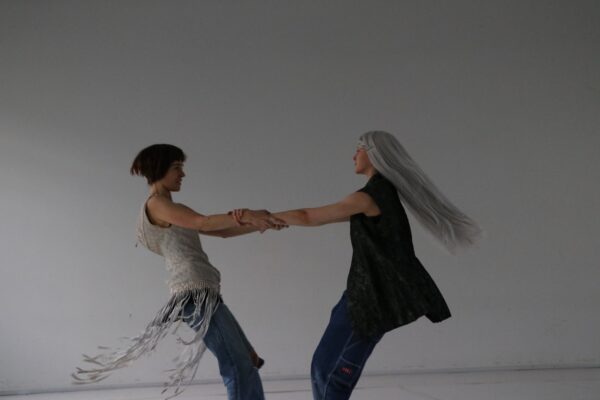
How can we resist gravity—or use it to move, or surrender to it? And how do we invoke centrifugal forces, how do we move within them, and endure the dizziness they create?
Two people on stage, exposed to centrifugal forces and gravity—not only in relation to “Mother Earth,” but also to one another. They play with attraction, repulsion, and longing. We invite you into a play with the floor, with rotational forces, and with the gravity between us.
Trailer
You are currently viewing a placeholder content from Vimeo. To access the actual content, click the button below. Please note that doing so will share data with third-party providers.
Credits
Choreography, Performance, Artistic Direction: Pauline Michel & Miranda Rivière
Sound: Szymon Wójcik
Dramaturgical Consultation: Micaela Kühn, Malin Astner, Inaja Skands
Photos: Bryce Rajkarnikar, with kind support from Den Danske Scenekunstskole
Video Trailer: Filmed by Paavali Kärkkäinen, edited by Pauline Michel, sound by Szymon Wójcik
Biographies
Miranda Josephine Rivière, *2002, was born and raised in the small Italian town of Urbino. From 2017 to 2021, she studied dance at Balletto di Toscana in Florence. She then completed her Bachelor’s degree in Dance and Choreography in Copenhagen at Den Danske Scenekunstskole (2021–24), spending one year as an exchange student at the Royal Conservatory in Antwerp. She is currently based in Copenhagen.
Pauline Michel, *1995 in Frankfurt am Main, completed her Bachelor’s degree in Sociology and Philosophy at the University of Freiburg in 2019. In 2020, she began studying contemporary dance at the University of Music and Dance Cologne (HfMT Köln). She later moved to Copenhagen to study at Den Danske Scenekunstskole, where she graduated with a Bachelor’s degree in Dance and Choreography in the summer of 2024. During and after her studies, Pauline worked with artists including Reut Shemesh, Cristian Duarte, Doris Uhlich, and Alma Söderberg. In 2025, she returned to Frankfurt, where she is currently establishing her professional base.
In talk with Pauline Michel
What was the starting point for your piece, and were there any particular challenges?
issa emerged from an interest in gravity, rotational movement, and centrifugal forces—how we move between these forces and, above all, in relation to one another. It is our first work together. As such, it was also a process of figuring out how we want to work together, what interests us both, and of developing helpful studio routines.
How do collaborations with musicians and dancers influence your creative process?
The music is by Szymon Wójcik. Collaborating was wonderful. It was exciting to observe how the music changed the movement material, sometimes placing it in different contexts or creating new situations or spaces around it.
How does your experience as a dancer shape your choreographic practice—and conversely, how does choreographing influence your work as a dancer?
For me, the two are very closely connected. Dance and choreography are not necessarily separate domains. When we started working in the studio on issa, the movement material and choreographic considerations emerged together, one from the other: because we had the physical experience of the movement material, ideas arose about how to arrange it; and based on choreographic considerations, we continued to experiment with the movement material. We were fortunate that several people attended our rehearsals as outside eyes and were able to offer an external perspective.
Have you ever experienced creative blocks? If so, how do you deal with them?
It helps me a great deal not to work alone and to inspire one another with new ideas. That way, I’m not limited to myself and my own notions. When I’m working alone and things feel tight, I usually try to continue with something else—something I enjoy—or simply change locations. That often helps already.
Do the current cuts in cultural funding affect your work? And if so, in what way?
I perceive the current moment as an enormous crisis in the dance scene. I personally feel that there are few jobs because choreographers do not receive enough funding, and programs that once existed are suddenly being cut. For those just starting out in the independent scene, it is difficult to gain a foothold and, amid all the frustration, not give up—and also to stay financially afloat.
With regard to the pieces in our Work in Progress program: when and how do you decide that a piece is finished—or do you believe a piece is ever truly complete?
In that sense, issa was already finished and had its premiere. Nevertheless, I find it more exciting not to regard the piece as completed—as something we merely repeat. It changes with the performances and the places we are in, and it demands our attention and presence. I think it never becomes a ready-made.