Digital Program Booklet “Silent Echo”

Credits
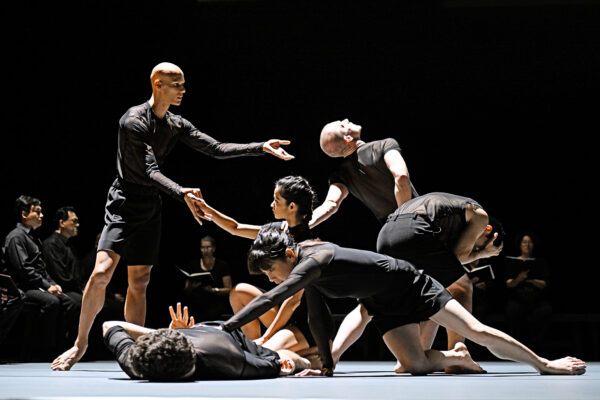
“I’m afraid to forget your smile”
Choreography: Imre & Marne van Opstal
Set & Lighting: Tom Visser
Dramaturgy: Lucas Herrmann
Musical Direction: Conductor Thomas Höpp
Choir: Schiersteiner Kantorei and Musikverein Darmstadt
Singers: Andrea Botar, Victoria Gomez, Simone Grün, Laura Hafner, Azita Mahiny, Eliane Regel, Beatrix Weber, Agnes Busch, Dana Dimitriu, Kirsten Körner, Birgid Merkel, Susanne Schöntaube, Regina Titzrath-Mahler, Sabine Wolf, Clemens Bosselmann, Stephan Lich, Adrian Möller, Leo Simanjuntak, Rolf-Detlef Treede, Tim-Felix Anderten, Luca Englert, Thomas Ludwig, Eugen Melnykov, Martin Tiedemann, Dietmar Wagner
Dancers: Ramon John, Peng Chen, Masayoshi Katori, Luke Watson, Sayaka Kado, Mei-Yun Lu, Bridget Lee, Daniela Castro Hechavarría, Anthony Michael Pucci, Marcos Novais, Enzo Boffa, Benjamin Wilson, Alessio Pirrone
World Premiere Darmstadt – 17 September 2022, 7:30 pm
Staatstheater Darmstadt, Großes Haus
Wiesbaden Premiere – 28 October 2022, 7:30 pm
Staatstheater Wiesbaden, Großes Haus
Trailer: De-Da Productions
“Midnight Raga”
Choreography: Marco Goecke
Music: Ravi Shankar / Etta James
Costumes: Marco Goecke / Nadja Kadel
Musical Direction: Waldemar Martynel
Dancers: Ramon John, Mei-Yun Lu, Benjamin Wilson, Marcos Novais, Sayaka Kado, Alessio Pirrone
Trailer: De-Da Productions
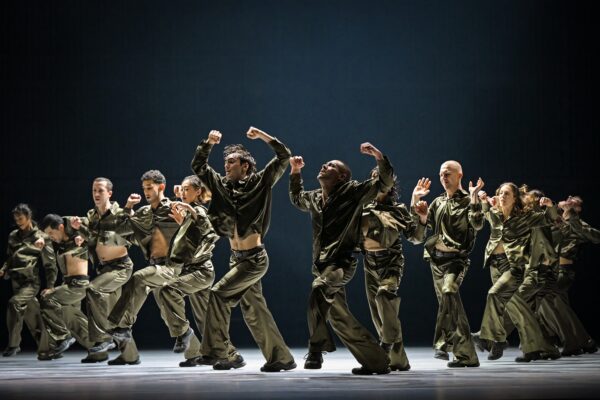
“The Mass Ornament”
Choreography, Set & Costumes: Fran Díaz
Lighting: Tanja Rühl
Stage Management: Uwe Fischer
Trailer: De-Da Productions
Dramaturg’s Note
Three Choreographic Worlds
by Lucas Herrmann
Silent Echo brings three acclaimed productions from the repertoire of the Hessisches Staatsballett back to the stage: I’m afraid to forget your smile by Imre & Marne van Opstal, Midnight Raga by Marco Goecke, and The Mass Ornament by Fran Díaz. The three works articulate highly distinct movement languages, yet converge around fundamental questions of what it means to be human.
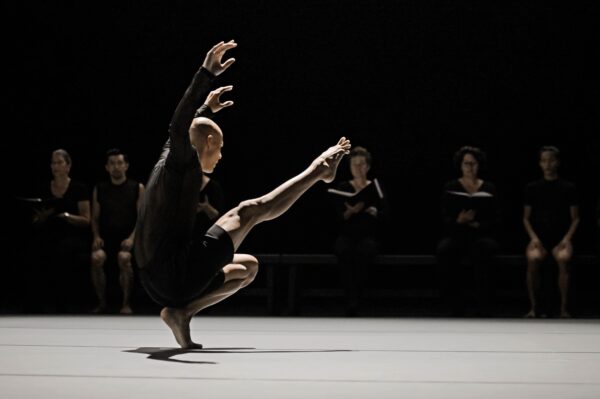
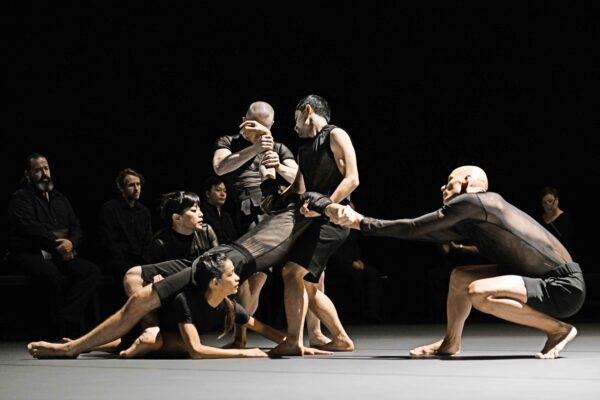
Imre & Marne van Opstal open the evening with I’m afraid to forget your smile. Sixteen bodies sit on benches, while six more lie within a space illuminated by glaring light. A chorale rises from collective voices. As if responding to a secret signal, those lying down begin striking their legs against the floor in shifting rhythms. The rhythm spreads, transforming the space into a powerful, percussive image of bodies: a sense of almost sacred grandeur meets the immediate, earthly force of the body. At first, voice and movement exist in tension with one another before gradually merging.
The choreography’s two-part structure moves from the individual towards the collective. Solos and duets initially appear as personal encounters with memories and emotions, while meetings and exchanged glances create fragile moments of intimacy. In between, silence emerges—moments of stillness that carry as much weight as the singing. In the second part, the dancers form larger groups. The choir’s polyphony becomes physically visible: the group strives for unity, achieves it for a moment, and then falls apart again. It is precisely the transience of these moments that gives them their intensity. They become images of a community whose very awareness of its own disappearance allows it to linger all the more powerfully in memory.
Premiered by the Hessisches Staatsballett in 2022 and nominated for the DER FAUST Theatre Prize in 2023, I’m afraid to forget your smile is a work about loss and letting go—and about the desire to hold on to what has been lost. Together with set and lighting designer Tom Visser, siblings Imre & Marne van Opstal create an ephemeral dance tableau of many colours and layers. Choral music by composers including Ola Gjeilo, Jóhann Jóhannsson and Arvo Pärt is performed live by the Schiersteiner Kantorei and Musikverein Darmstadt under the direction of Thomas Höpp.
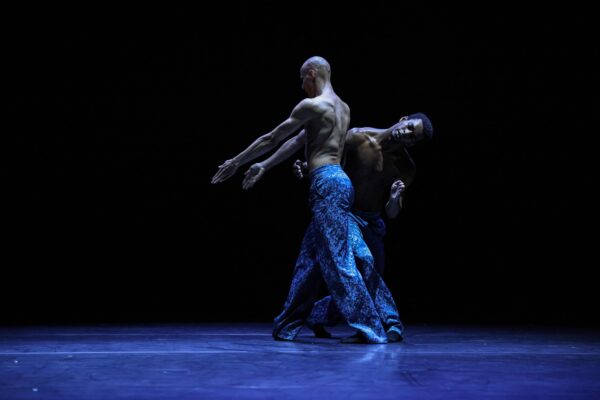
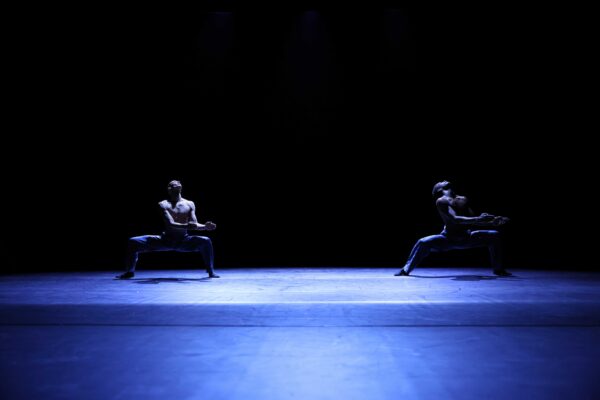
A deep midnight blue defines the second part of the evening: Marco Goecke’s Midnight Raga. The title refers to the raga, a form of classical Indian music based on melodic structures traditionally associated with particular times of day and emotional states. Unlike Goecke’s usual working process, the music served as the starting point for the choreography. It is by Indian sitar virtuoso Ravi Shankar and comes from his legendary performance at Woodstock in 1969.
Goecke was fascinated in equal measure by its mystical and unfamiliar qualities. At the same time, he was intrigued by the idea of drawing inspiration from Indian music without adopting its culturally specific dance elements. A musical world rich in ritual and spiritual associations thus encounters his unmistakable movement language. For the two dancers, this language is tailor-made: nervous, precise, vibrating and requiring intense physical concentration. The smallest movements can take hold of the entire body; gestures seem to travel like electrical impulses through the arms, hands and torso. The heavy blue silk of the costumes echoes the atmosphere of the work, heightening the sense of a nocturnal, otherworldly realm. Alongside Shankar’s music, a live recording of Etta James’s famous blues and soul classic I’d Rather Go Blind is played, lending an intimate quality to the dance between the two bodies. Midnight Raga is a duet about tension and intimacy, unfamiliarity and connection, and another example of Goecke’s ability to transform music into an immediate physical experience.
The Hessisches Staatsballett was the first company to restage the work, which premiered at Nederlands Dans Theater in 2017, and also presents the piece—originally created for two men—with a female cast.
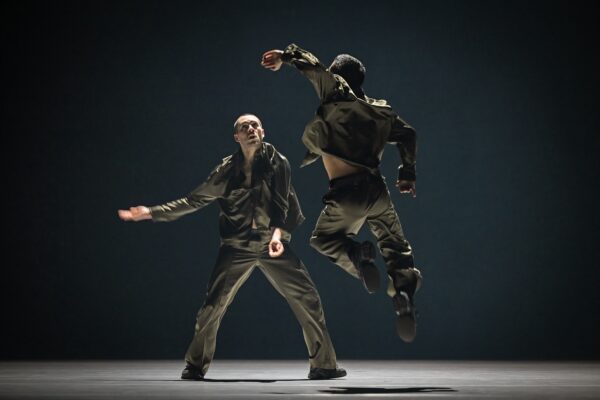
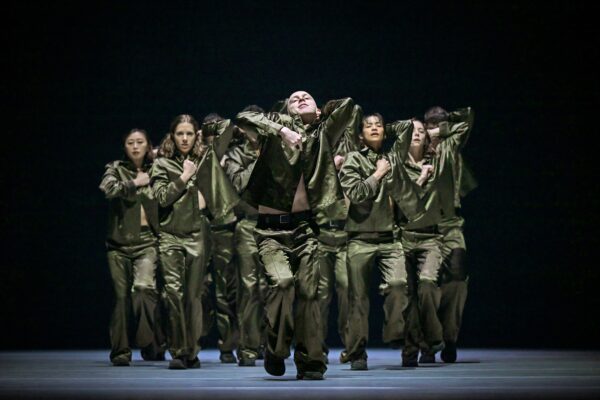
In the evening’s sweeping finale, The Mass Ornament, Spanish choreographer Fran Díaz engages with an idea by philosopher and sociologist Siegfried Kracauer. In his essay collection The Mass Ornament, Kracauer uses the example of the Tiller Girls of the 1920s to describe the rationalisation and synchronisation of bodies as an expression of a society shaped by mass production. Díaz brings this idea into the present, making the group itself the choreographic material.
Precise formations, recurring patterns and ever-changing configurations shape the progression of the work. Set to Henryk Górecki’s Concerto for Harpsichord and String Orchestra, Op. 40 and an additional composition by Tom Foskett-Barnes, the dancers become part of a complex system in which individuality recedes in favour of the whole. The movement demands the utmost precision and awareness, while also requiring intense physical exertion. Dance becomes an element within a higher order that can function only when everyone submits to it. Yet even within this seemingly perfectly organised collective body, moments of individual humanity break through. A kiss can become the final bastion of personal intimacy—a small, intimate gesture that resists the logic of the system.
With The Mass Ornament, the Hessisches Staatsballett brought its acclaimed anniversary marathon Chronicles, celebrating the company’s tenth anniversary in 2024, to a close. The work recently received its Australian premiere in a restaging by Sydney Dance Company.
Three works, three choreographic worlds. What connects them is the question of what happens between people—and what remains. They explore memory and identity, intimacy and distance, community and individuality, and the traces that encounters leave behind: a silent echo.
In Conversation with Imre & Marne van Opstal
Miniatures of a Remembered Life
In your work, you explore mortality. As a young choreographic duo, how did you come to address the subject of death?
Imre: One of our cousins died very young. We also experienced another person close to our family going through the process of dying. That brought the reality of death somewhat closer to us. And, of course, there were our experiences during the pandemic—the realisation that it can happen to you at any time and that you have no control over things.
Marne: It was important to us that both the dancers and, later, the audience would develop a personal connection to the piece. After all, it also asks what it means to be alive, to have a body, to gather experiences, to feel love. In the end, everything passes into something else, moves towards a new place. We, too, continue to rediscover this piece throughout the process.
How did you approach working with the dancers on such an existential subject?
Imre: We cannot enter into a genuine exchange without knowing something about the people we are working with. So we asked them to write down their experiences and thoughts about mortality in a letter. This puts them in a very vulnerable position, but ultimately it brings us closer together as a team.
Marne: Through this, the dancers learned things about one another that they hadn’t known before, things they had never heard. They may not even have realised some of these things about themselves. But while writing, they had to delve into their memories.
Imre: You start digging a little deeper into yourself. It is important to us to create a safe space where there is trust and where people can also let go if they are in pain or feel like crying.
Marne: It has a cathartic effect. It takes a lot for people to be willing to show vulnerability and allow emotions to move through them. Despite the weight of the subject, we tried to keep things light and approach it more through physicality than through drama. But a creative process is also about finding a back door and allowing moments in which the dancers are overwhelmed by their own emotions in the studio. There is something beautiful about that—it makes them human.
How did the idea of working with choral music come about?
Imre: We wanted to have live elements in the piece. At first, we weren’t sure whether it should be a band or a chamber quartet. Then the idea of working with a choir emerged. It is a new experience for us. We listened extensively to the choral repertoire, which is incredibly broad and multifaceted. There are so many different styles. But for us, it was more about a feeling, about finding a similar kind of frequency. We were less interested in a particular historical period, such as the Renaissance or Classical era, and more in contemporary compositions. At the same time, these pieces also have a kind of “old-school feeling”. The idea of a choir is, of course, very spiritual and carries specific connotations.
Marne: But the human voice is also an incredibly powerful medium, especially when experienced collectively. There is something very primal about it. Just like dance. The body and the voice are fundamental realities. They have been with us since the beginning of time and will remain with us until its end.
How do you engage with this music choreographically?
Imre: For us, there was a risk that the music might be too beautiful. We wanted to create friction through contrasts and different rhythms. The piece is more concerned with the feeling of physicality, so we had to approach it differently than we usually do. When the music is already given, attempting to interpret it choreographically can easily become too dramatic. In the first part, we work more strongly against the music, creating greater friction and rhythm in the movement—a kind of “wild layer”. In the second part, dance and music come closer together before being disrupted once again through the choreography at the end. Because our movement language is already so detailed, with its inherent friction and ruptures within the body, from the outside it probably looks as though the dance does not really relate to the music at all.
Where is the dancers’ focus? Do they relate to the music or to one another?
Marne: They relate to one another, but above all to themselves. Each individual moment creates the next. This places them in a constantly evolving situation. They only find unity in what we call the “family portrait”, which introduces the second part. Everything before that is fairly separate and more introspective. The opening scene of the piece is conceived as a shared experience, but the dancers move more around one another than with one another.
You use the term “family portrait”. How much does painting influence your work?
Imre: We used various paintings as inspirational material during rehearsals, but we don’t make any direct references to them. There is so much symbolism surrounding death in painting. The connections we create here do not necessarily come from paintings that deal explicitly with death. It was more about the painterly feeling these images evoke within you. This is conveyed above all through the relationships between the people depicted in them. When you look at them, you suddenly sense a miniature story that begins to shift and change.
Again, it is about life, about different stages involving different groups of people, relationships and situations; an abstraction of what these people might possibly mean to one another. Perhaps it is simply a snapshot in time. We look at it and think: “Oh my God, that’s a memory!”
Can you describe the setting you chose for the work?
Marne: It is a kind of waiting room, an in-between space, almost like purgatory. At the same time, a square area bordered by benches on which the choir sits creates the impression of an arena. Softboxes illuminate this space from above. They create a directional light that appears to fall through windows, almost like light through church windows. Perhaps there is a connection here to that painterly quality as well.
The costumes were intended to be individual without revealing a particular character. The focus is on physicality. The same applies to the choir, who are simply dressed in black. Yet with so many bodies—with sixteen additional energies in the space—far more context emerges. The whole thing feels like an installation while simultaneously creating a kind of “cinematic feeling”. Perhaps the piece could also work as a site-specific project.
What does the title mean to you?
Marne: Most people are afraid of forgetting someone when they die. Of forgetting their face. Today, of course, we have photographs. But often it feels as though memory fills in the rest. That is how our memory works: we fill in the gaps, and we alter things as we remember them. The only place where people continue to live on is in our memory.
Imre: But ultimately, perhaps it is also about a very personal experience—the fear of forgetting someone’s smile, forgetting how someone smells, how they sound, or how they make you feel. The idea of the smile is important because it is about a positive memory. It is about how that person made you happy. At the same time, there is a beautiful contradiction within the title itself, between the words “afraid” and “smile”. Another miniature story …
Imre & Marne van Opstal
Imre & Marne van Opstal
Dutch choreographers and acclaimed performing artists Imre & Marne van Opstal are siblings who form a creative duo. Following successful dance careers with Nederlands Dans Theater (NDT 1 & NDT 2) and/or Batsheva Dance Company, they began pursuing their own creative work.
The collaborative nature of their practice often explores the human condition and the limits and possibilities of body and mind. Their work is multilayered and surreal, characterised by a powerful, unfiltered movement language known for its eclecticism, theatricality and partnering.
They made their choreographic debut in 2014 with LiNK, created for the talent development programme Up & Coming Choreographers. This was followed by John Doe for Up & Coming Choreographers in 2015. In the 2016/17 season, their creation The Grey marked their choreographic debut in NDT 2’s regular programme.
In 2019, they created their highly acclaimed first work for NDT 1, Take Root, which was nominated for the Dutch Zwaan Award for “Most Impressive Dance Production”. From 2020 onwards, both focused exclusively on choreography. In 2021, they created the acclaimed Baby don’t hurt me for NDT 1, exploring themes of identity, sexuality, gender and love.
Their more recent creations include Eye Candy with Rambert Dance Company and The little man for Nationaltheater Mannheim.
In Conversation with Marco Goecke
Building Blocks and Other Trips – A Double Dose of Life
Looking back at the creative process behind Midnight Raga, what was your starting point?
It was a commission from Nederlands Dans Theater. I was glad, for once, not to be creating a large narrative ballet. Basically, it’s always a carte blanche along the lines of: “Make something for us.” Strangely enough, I didn’t feel any urge to tell a story. I mean, I read a lot, but most of the time I’m lying in front of the television with my dog. In any case, there’s always the question: where do you find the courage to create something that doesn’t yet exist?
But you did find that courage somewhere.
A good friend had sent me some music by Etta James on YouTube, and at the same time I was exploring Woodstock. That’s how Ravi Shankar came into it. They’re all little building blocks that came together during that period, or even before. I’ve never really had one fundamental idea when creating abstract works. The exhaustion I feel after 25 years as a choreographer also comes from having wrestled all of this out of myself without knowing exactly what it is. I think that’s actually quite courageous. Especially since I’m not exactly the biggest fan of my own work.
So you approached the piece through the music?
When I think of Woodstock—this piece is also a kind of trip, and you enter a sort of trance. It feels like a double dose of life. Everything feels twice as intense on stage. Etta James is perhaps something more real, something that brings you back out of that trance. Sometimes you just feel that something is right for you and you leave it that way. Having been born in Wuppertal, I’ve always felt that collage and sudden shifts in music are important when you want to express something particular. Perhaps something feels right because you sense it very deeply. And when something is right, it makes sense without having to find words for it.
What does music mean to you?
As a young choreographer, I used to wander around Stuttgart with my Discman and CDs in my little bag. It was simply a wonderful time—walking around with headphones on and dreaming about something. In Etta James’s music, I discovered a very deep sense of truth and passion. That passion is something I’ve always searched for and wished for other people. For young people. And I think I’ve managed to fulfil that wish in my own life as well. Like Woodstock, it’s quite a trip.
Are rehearsals with the dancers a similar kind of trip?
A lot emerges from the encounter itself. I notice very quickly what the dancers are capable of and what they are willing to do. I can respond to that. When I created Midnight Raga at Nederlands Dans Theater, anything was possible with the two dancers, Alexander Anderson and Guido Dutilh. There was this dizzying sense of possibility, and I thought: how much further can I go? Perhaps it’s like making love. When you love someone deeply and sleep with them, there is a moment when you simply cannot get any closer because you have already reached the limit of intimacy. There’s something to the expression about loving someone so much you could “eat them up”. I feel something similar in Midnight Raga. With closeness there is always also the despair of knowing that you remain separate.
I can imagine that this makes for a very intense working process.
We actually always have a lot of fun in rehearsals, and the dancers really enjoy working with me. I always go into the creation of a piece wanting to have a good time and achieve something meaningful. Of course it’s intense. But most of the dancers I’ve met want to experience something like that. To a certain extent, perhaps they’re masochists, searching deep within the struggle. And if they’re a little masochistic, then perhaps I’m a little sadistic in that respect. I experience the development of a piece like a love affair, or like falling in love for a certain period of time—with all its facets and insecurities and the testing of boundaries. Once the piece is finished, that love affair is simply over.
So what happens when a work is restaged?
Bringing a piece back evokes that feeling of loss. You can’t simply copy it. It’s just like love: you can’t force the other person. That’s actually an interesting thought. But what is also important in a restaging is that you see the piece anew and reignite it. That isn’t nearly as easy as some people might think. Sometimes I wish the people watching knew how much energy it takes. There’s no amount of money that could really compensate for it, and yet dance artists are among the lowest-paid artists in the cultural sector.
Would you restage your own works yourself?
I tried it once, but I constantly had to run back to the video. Being a ballet master is an incredibly demanding job—spending weeks working on a single piece. I’m not even sure I’d want to do that. And of course it’s also terrible having to revisit old love affairs. There’s another kind of madness in me that communicates different information. That can certainly be valuable for the dancers, but I have great trust in the people who restage my works.
What significance does the colour blue have for you?
Blue is definitely my favourite colour. People always think I wear black, but I’m always wearing blue. My blue anorak. The costumes in the piece have a subtle pattern inspired by Indian designs. Ultimately, I explored Ravi Shankar more extensively than Etta James. Shankar is Norah Jones’s father—I had no idea. Did you know that?
No.
He was one of the most important Indian musicians of the 20th century. A raga is a form of Indian music. There is a “Morning Raga” and an “Afternoon Raga”. These are traditions. I don’t even know what time Shankar performed at Woodstock. But there certainly wasn’t a “Midnight Raga”. I believe that the night is never black; somehow, it is always blue. And besides, “raga” in Italian slang also means “guys” and is used as an affectionate term for “friends”. They’re all just little building blocks.
Marco Goecke
Marco Goecke
Marco Goecke began his ballet training in 1988 at the Ballet Academy of the Heinz Bosl Foundation in Munich and continued his studies at the Royal Conservatoire in The Hague, where he graduated in 1995. Engagements at the Staatsoper Berlin and Theater Hagen followed. At Theater Hagen, he created his first choreography, Loch, in 2000. This was followed by several works for the Noverre Society featuring dancers of the Stuttgart Ballet, as well as an invitation to the New York Choreographic Institute. In July 2003, Goecke won the Prix Dom Pérignon in Hamburg with Blushing, performed by the Stuttgart Ballet. In the years that followed, he received numerous commissions from international companies, including Les Ballets de Monte-Carlo, Norwegian National Ballet, Pacific Northwest Ballet in Seattle and Staatsballett Berlin.
In the 2005/06 season, Marco Goecke was appointed resident choreographer of the Stuttgart Ballet. In December 2006, he created his first narrative ballet for the company, The Nutcracker, which was later filmed for the ZDFtheaterkanal. From 2006 to 2012, Goecke also served as resident choreographer at Scapino Ballet Rotterdam. From the 2013/14 season onwards, he was Associate Choreographer at the renowned Nederlands Dans Theater. From 2019 to 2023, he was Artist in Residence at Gauthier Dance and, during the same period, Artistic Director of Staatsballett Hannover.
Many of his more than ninety works have been restaged by companies around the world, including the National Ballet of Canada, Stanislavsky Theatre Moscow, Ballett Zürich and the Vienna State Opera.
Goecke has received numerous international awards, including the Cultural Award of the State of Baden-Württemberg in 2005, the Nijinsky Award in Monte Carlo in 2006, Choreographer of the Year in the critics’ poll of tanz magazine in 2015, the Dutch dance award Zwaan in 2017, as well as the Italian Danza&Danza Award for Best Choreography of the Year. In 2018, his work Wir sagen uns Dunkles, premiered by NDT, was nominated for the Prix Benois de la Danse. In 2022, he was awarded both the Jiří Kylián Ring and the German Dance Award.
His more recent acclaimed works include the full-length A Wilde Story, inspired by writer Oscar Wilde and created for Staatsballett Hannover, as well as In The Dutch Mountains, created for Nederlands Dans Theater in 2023.
In conversation with Fran Díaz
In Conversation with Fran Díaz
How does your work relate to Siegfried Kracauer’s The Mass Ornament?
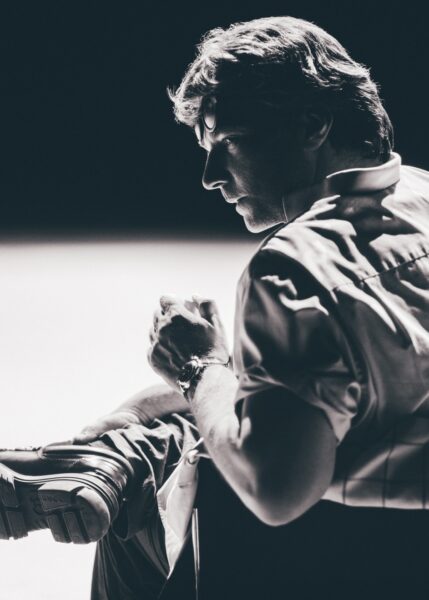
I’m interested in Kracauer’s reflections on popular entertainment, such as the synchronised dance routines of the Tiller Girls, as a reflection of capitalist rationalisation. Their geometrically precise choreographies reflect the mechanised logic of mass production. I wanted to create a human “mass ornament” within a contemporary neoliberal context—in a world that regards individuality as radically free, yet shapes it through economics and technology. During the creative process, a network of care and collaboration emerged in which individuality and collectivity do not contradict one another but instead exist in dialogue.
How do you develop your choreography in relation to Henryk Górecki’s rather fast-paced music?
Górecki’s Concerto for Harpsichord is a short but intense work consisting of two contrasting movements. The first, romantic yet mechanical, stands in contrast to the fragmented choreography. The second, with its feverish energy, takes up Kracauer’s idea of the dissolution of the self within rigid structures and reflects the principle of the mass ornament. The choreography mediates between these opposites in an interlude by Tom Foskett-Barnes, gradually transitioning from chaos into ordered movement.
What role do set, costumes and lighting play in your work?
Given the complexity of the choreography and music, I opted for a minimalist design. The costumes in particular are a subtle reference to American dance ensembles of the 1980s—a simple, contemporary silhouette that functions both as a uniform and as a reference to Kracauer’s engagement with American culture. I wanted to create an aesthetic that vaguely evokes A Chorus Line (1985), suggesting a world in which performance, discipline and spectacle converge.
Fran Díaz
Fran Díaz
Fran Díaz is a Spanish choreographer based in Germany. He studied at Canada’s National Ballet School in Toronto and worked as a dancer with Leipzig Ballet and Staatsballett Hannover under the direction of Marco Goecke before turning his focus to choreography.
His work, which frequently takes the form of multidisciplinary projects, often explores ideas of community, the need for a sense of belonging, and the reconfiguration of physical spaces and boundaries. He is also interested in intersections with queer culture and in shaping institutional structures.
In 2020, his choreography Toothpicks won third prize at the International Choreographic Competition in Hanover, and in 2021 he was a finalist at the International Choreographic Competition in Copenhagen with I’ll do the talking.
In 2023, he premiered The Habit, a new work for the Bayerisches Staatsballett, as well as two new works in the independent dance scene, Born by the Sea and Scheme. The latter examines the challenges of structural change through an exploration of complaint processes within dance institutions.