Program booklet Corps de Walk
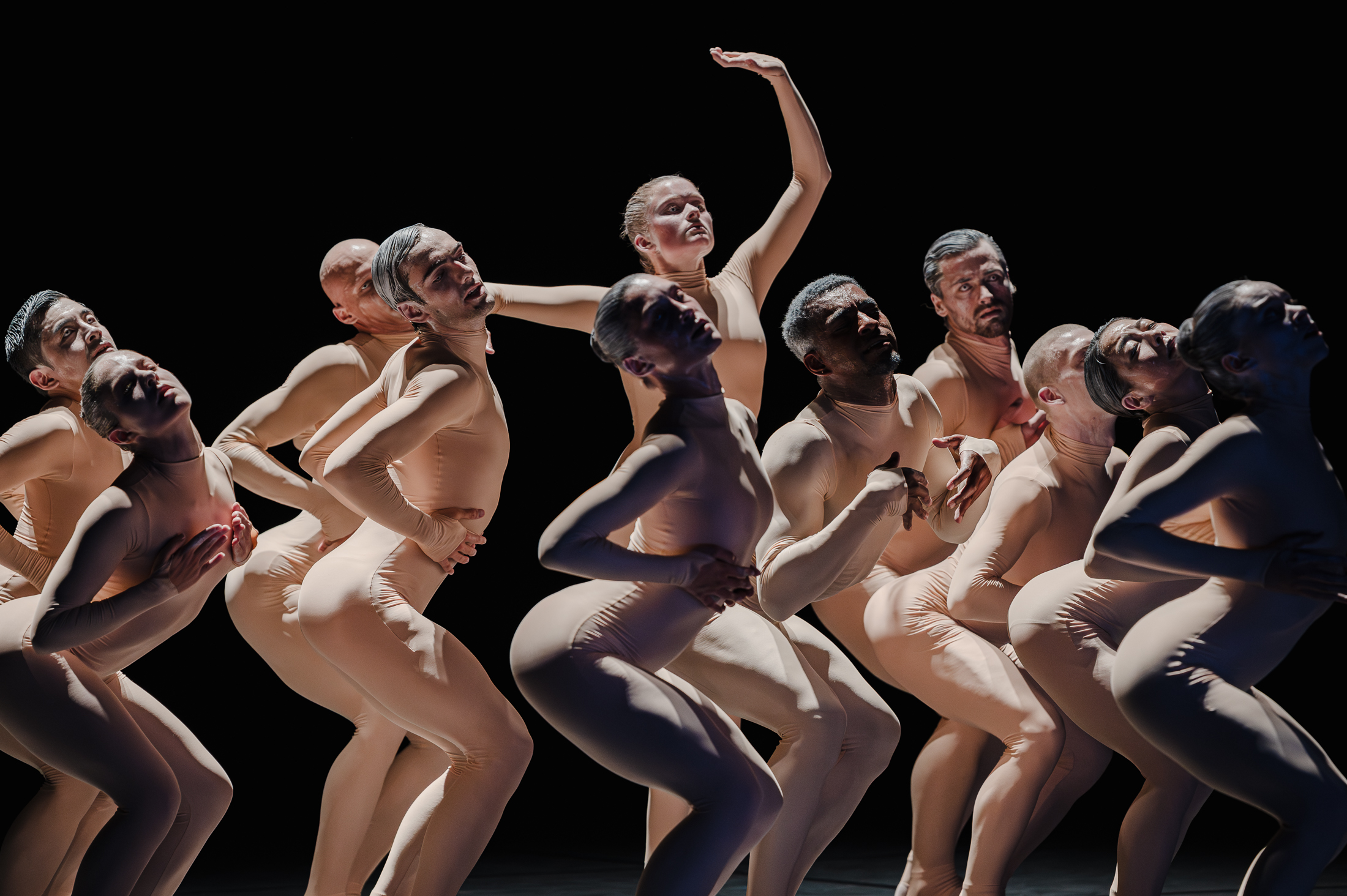
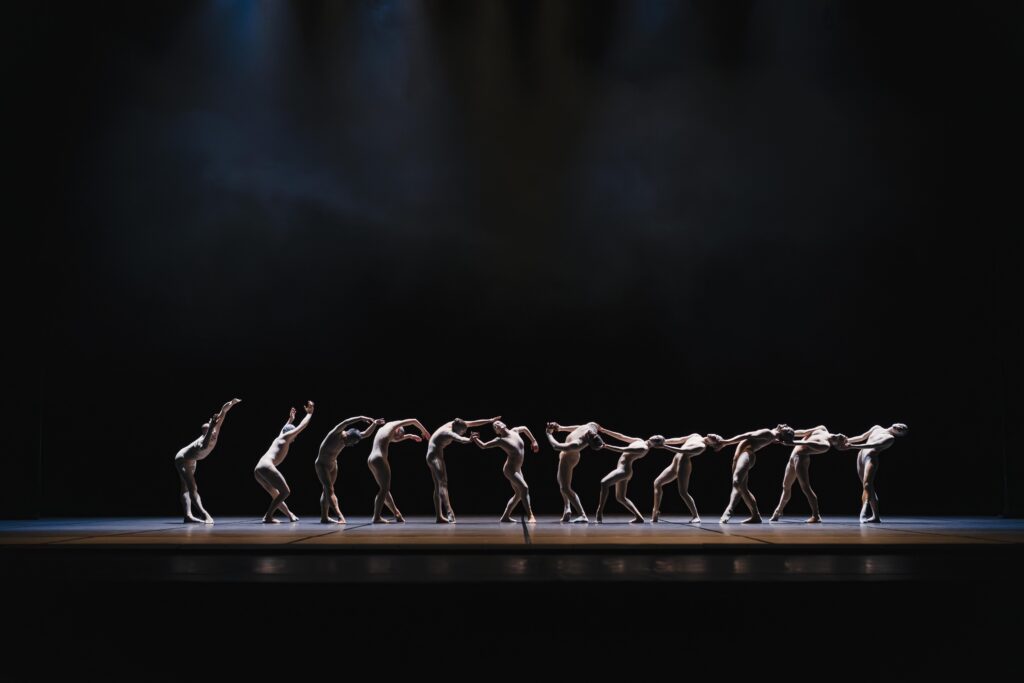
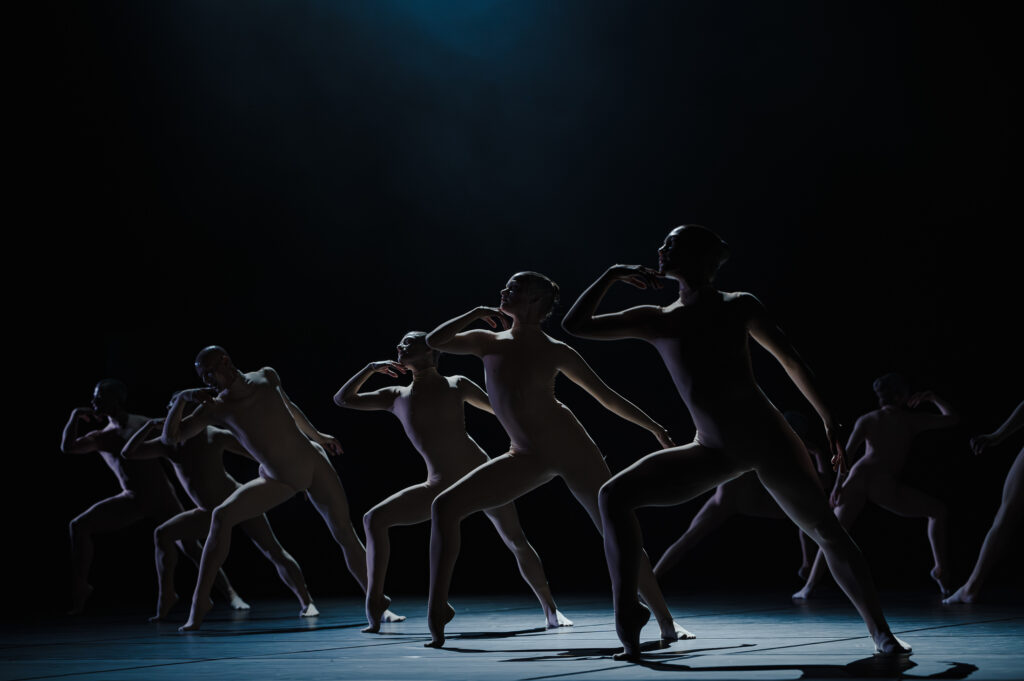
For nearly two decades, Sharon Eyal and her unique dance aesthetic have been triumphantly present on Europe’s stages. Corps de Walk is a piece created at the start of the choreographer’s international breakthough. This work, commisioned by the Norwegian national company of contemporary dance, Carte Blanche, in 2011, is now considered a modern classic of contemporary dance. The dancers, clad in beige bodysuits, white contact lenses, and identical hairstyles, appear like androgynous aliens. With precision, these alien figures move in geometric marching formations, oscillating between robotic parades and ecstatic pagan fertility rituals. Almost 15 years after ist premiere, Corps de Walk is being restaged by the Hessian State Ballet—the very company whose artistic director, Bruno Heynderickx, once held the same position at Carte Blanche and originally commissioned the piece from Eyal. This restaging also continues the successful collaboration between the Hessian State Ballet and Eyal, which most recently thrilled audiences in Darmstadt and Wiesbaden during the 21/22 season with Untitled Black.
Pictures
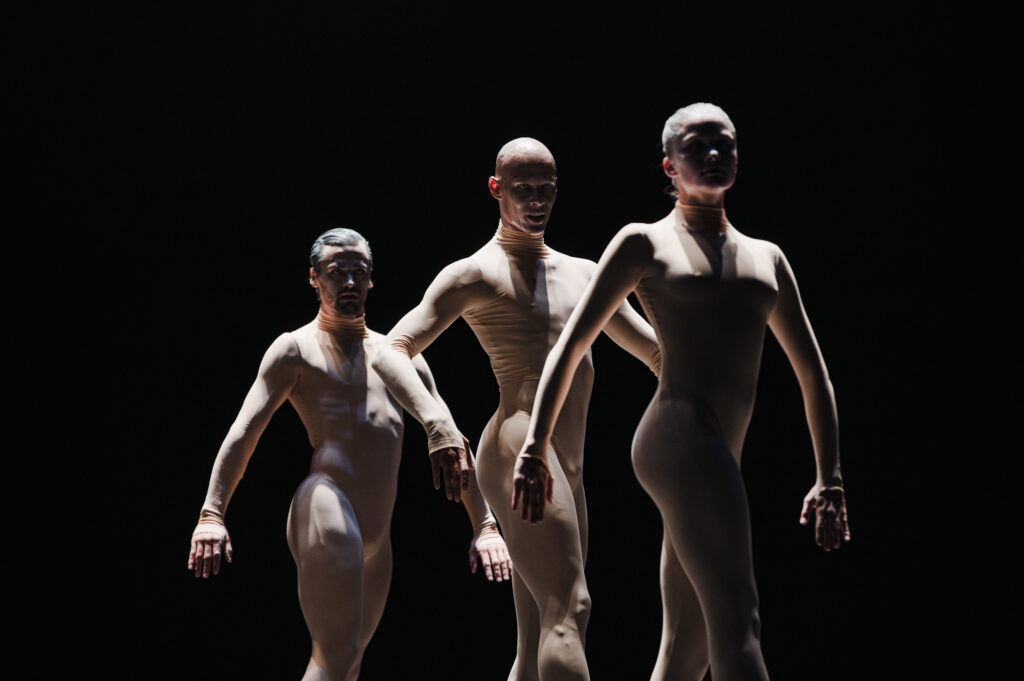
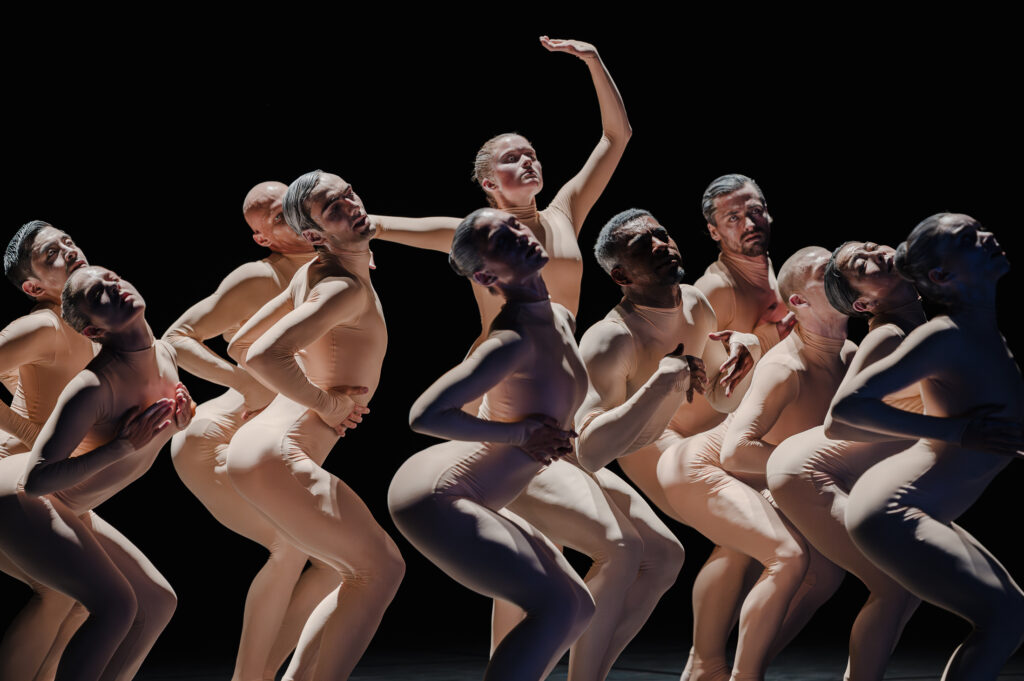
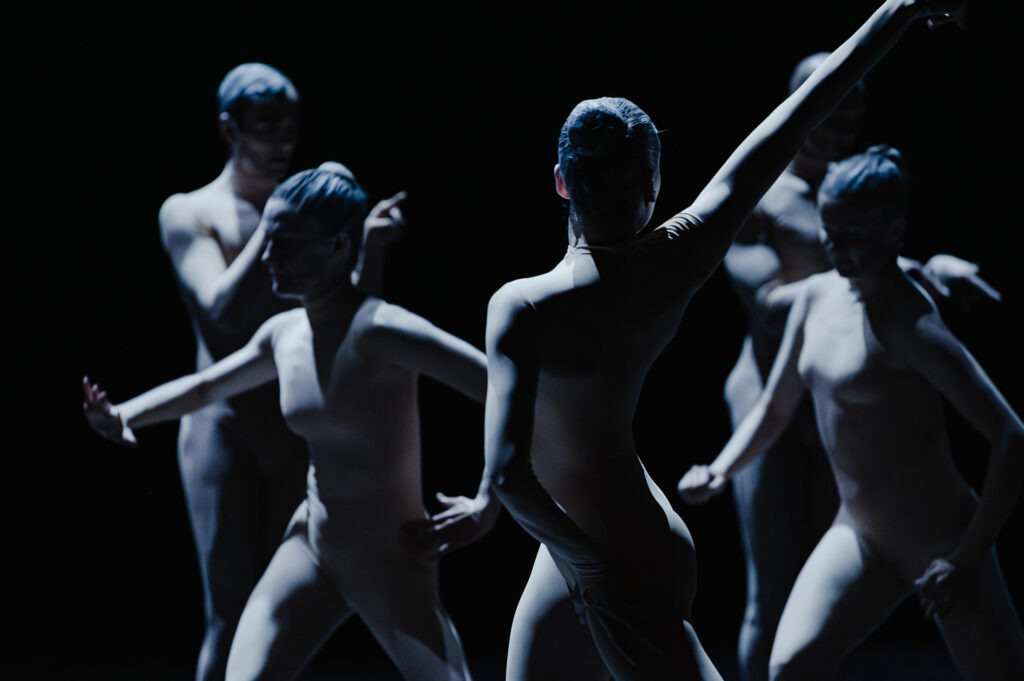
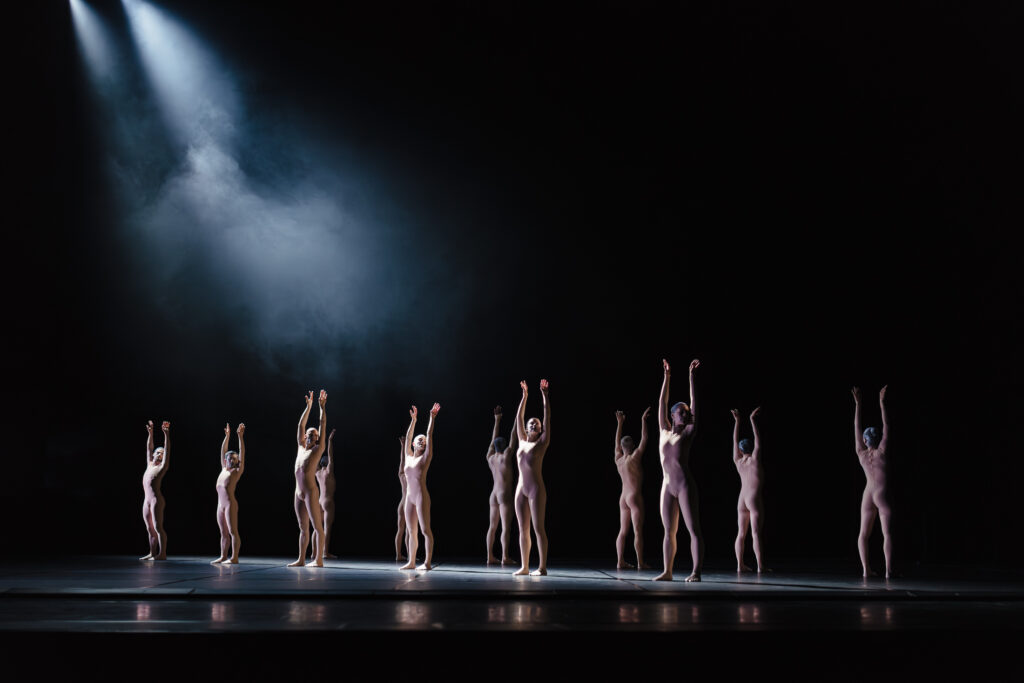
(c) Sinah Osner
Dramaturg’s note
A Dance of Life
The very first step opens a universe. Corps de Walk by Sharon Eyal is not a dance piece one simply watches – it is an experience that inscribes itself into the body.
Even the title is a statement that plays with contrasts: “Corps” refers to the body and, at the same time, to the corps de ballet, the unity of dancers in classical ballet. “Walk,” on the other hand, points to something everyday, almost banal – walking – and thereby breaks open the strictness of the collective.
“For me, walks are the new dance,” Eyal once said when she created Corps de Walk in 2011 for Carte Blanche, the Norwegian National Company of Contemporary Dance. What sounds so simple holds a radical insight: within walking lies the origin of dance, and in the simplest step, the greatest power of expression. Out of the everyday emerges a universe of movement that is hypnotic and unmistakable. Sharon Eyal’s works have left a lasting imprint on the contemporary dance scene. With Corps de Walk, at the beginning of her international breakthrough, she already shows how dance goes beyond movement, how it can convey existential experiences and awaken collective emotions. The dancers move as if guided by a secret energy, born from within their bodies, flowing through their muscles, setting their limbs into resonance. At times, they appear as one pulsating mass, almost like a swarm that effortlessly forms and dissolves again. Then, suddenly, an individual steps forward – with a small gesture, a look, a stance that briefly breaks the spell of the collective. It is this tension between unity and deviation that creates the magic of Corps de Walk. The dancers resemble one another – and yet they are never the same. Their steps repeat, circle, intensify into an almost trance-like state.
The music of Ori Lichtik accompanies and amplifies the striking stage language of the work. Lichtik weaves natural soundscapes with synthetic and electronic beats, blending in elements of industrial and techno. This mixture creates an atmospherically dense, at times oppressive soundscape that supports and underscores the dancers’ flow of movement – from robotic precision to hypnotic group dynamics. Oscillating between minimalism and ecstatic force, Lichtik’s music becomes an equal partner to the dance and an active part of the performance. It drives the group like a heartbeat, imposing an inexorable energy, while also allowing moments of tenderness and introspection. In this interplay unfolds an atmosphere that recalls a celebration, a ritual, even an intoxication. The tension between perfection and deviation, between uniformity and freedom, becomes a central theme.
Corps de Walk is both strictly composed and fluidly alive. The repetition of movements feels almost like a mantra, while sudden ruptures provoke disorientation. A collective breathing arises, a shared pulse that fills the space. And yet, each body remains unique – with its own stories, tensions, and secrets.
The stage becomes a mirror of our world. In the dancers we recognize our own longing for belonging, our need for closeness, our desire to be part of something larger. At the same time, we feel the power of resistance: the wish to assert one’s own voice, to free one’s body from the movement of others, to take one’s own path. Eyal succeeds in making these experiences visible without forcing them into a narrative.
Corps de Walk unfolds its impact not through storytelling but through presence. It is a piece meant less to be understood than to be felt – physically, directly, intensely. Every moment tells of us: of the rhythm of everyday life, of the synchronized steps we follow, and of the instants in which we break free. Of silence and of uprising. Of the collective that carries us, and of the solitude that remains.
Eyal herself often describes her works as a search for truth. Her dancers give everything – physically and emotionally – creating a space where audience and stage meet directly. The boundaries between watching and participating begin to blur – one is drawn into a current of movements, glances, rhythms. The audience is invited to surrender to this stream of energy, to be moved – by sounds, by bodies, by a force that connects us as human beings.
What remains is an echo of steps and glances that feel almost like our own. Corps de Walk does not let us go because it touches something deep: the experience that we are always part of something larger – and yet irreplaceable as individuals. When, at the end, the dance slowly releases itself from its trance, what lingers is the memory of a journey that lies somewhere between dream, celebration, and revelation. A dance of bodies, a dance of humanity, a dance of life.
Sharon Eyal
Since 2005, Sharon Eyal has collaborated with Gai Behar. In 2013, they founded the ensemble S-E-D (formerly L-E-V), with which they have performed on some of the world’s most prestigious stages and festivals, including The Joyce Theater in New York City, Jacob’s Pillow in Becket, Sadler’s Wells in London, Montpellier Danse Festival, and Julidans in Amsterdam.
In addition, Eyal has created works for leading companies worldwide, among them Jakie and Into the Hairy with S-E-D for Nederlands Dans Theater, 2 Chapters Love for Staatsballett Berlin, as well as ima and SAABA for GöteborgsOperans Danskompani.
Her choreographic work has received numerous awards, including the FEDORA – Van Cleef & Arpels Prize for Ballet in 2017 and the German theatre prize DER FAUST in 2018. In 2023, she was honored in France with the title Officière de l’Ordre des Arts et des Lettres.
Gai Behar
As a party producer, Gai Behar helped shape Tel Aviv’s club scene and, from 1999 to 2005, curated multidisciplinary art events. In 2005, he collaborated with Sharon Eyal on her piece Bertolina. Since then, he has been involved in the creation of her works.
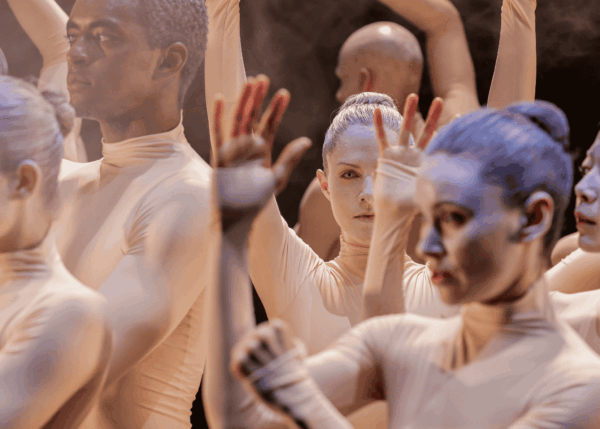
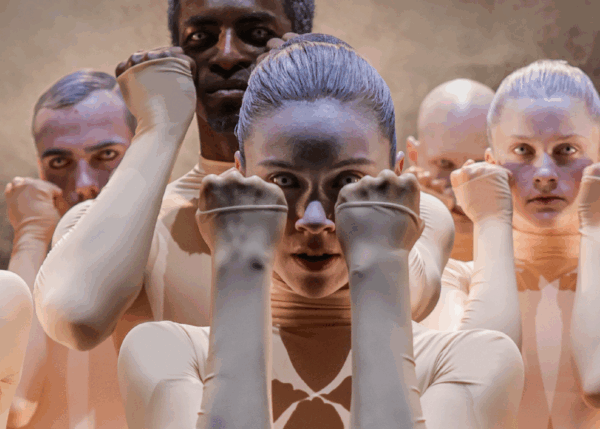
(c) De-Da Productions
In conversation with Olivia Ancona
The heart of a dancer
Olivia Ancona
Choreographic restager of Corps de Walk
What, for you, characterizes Sharon Eyal’s choreographic style – and how does it differ from that of other contemporary choreographers?
Someone once said: “Sharon is the heart of a dancer,” and I think that captures her essence very well. As a performer, she embodies the passion and spirit of someone who has danced their entire life. This feeling runs like an undercurrent through all her works. It becomes contagious for the dancers who perform her pieces and palpable to the audience – through the interplay of all elements: physicality, composition, light, and music.
How do you approach teaching the choreography to our dancers?
I work through the material step by step, breaking down the different layers that make up each piece. I prepare for months in advance to learn every movement, every count, every fine nuance of expression in detail, and to understand the specific qualities of the work. Once I’m in the studio with the dancers, it becomes much more enjoyable to engage in genuine exchange. I transmit the material in layers – first the movements in relation to timing, then the qualities and how to embody them physically. Through repetition, we practice listening to what the material evokes in us, and in this way we not only learn the movements but also become more familiar with the sections of the piece. Sharon’s works demand intense concentration and presence – which means that although the “score” is fixed, the experience of the steps will be different with every repetition. Our goal is to listen to this inner experience – for the sake of aliveness, for ourselves, and ultimately for the audience.
In Corps de Walk, the dancers’ bodies often merge into a collective – how does this sense of unity arise on stage?
There are almost always groups moving in unison. This serves as an anchor for Sharon’s work and applies even to a solo, which exists as a branch, an extension, or a representation of the collective. If twelve people were to move only their eyes, from a distance one might not notice something so small. But the power of the group acts like a magnifying glass, amplifying even the subtlest movements. Even in her use of unison, there is always space for individuality. This reflects life itself – and makes the experience of such relentless group work feel truer than mere perfection or strict regimentation.
To what extent is the piece, for you, abstract or narrative – or perhaps both?
The feelings are real, the physicality is rigorous, and the imagination is abundant – but I do think it’s fair to say the piece is abstract. I feel it conveys joy and lightness in a way unusual for Sharon’s work – especially in a choreography that seems so militant on the surface.
How does your relationship to the piece change over the course of rehearsals?
The layers of learning, understanding, and engagement grow over time. What sometimes begins dryly – “What do I do when?” – turns into the individual journey of each person, both within the piece and through the process. As a rehearsal director, my goal is to balance the needs of the work with the everyday and to truly see the people in front of me. The questions I ask myself become more nuanced over time: How do I best transmit the steps? How do I manage time and energy? How can I help the dancers discover more of themselves by using the precision of movement? How can I witness their own research and performance? My focus shifts from counts and movements to people and process, toward the bigger picture – and ultimately to how all the elements come together in performance.
What do you take away from working on Corps de Walk – both as a dancer and as a human being?
It is my first time working on Corps de Walk. I was thrilled at the prospect of working on a unique full-length piece by Sharon and Gai – and one created back in 2011. I approached this great task with trust in the Hessisches Staatsballett, since this is my second collaboration with the company and my previous experiences there have been so positive and formative. The work requires utmost focus, memory, precision – and at the same time confidence, individuality, and humanity. Personally, I find this friction exciting – both as an artist and as a person. I learn an enormous amount from the talented dancers, who absorb information faster than they can process it. The more often I get to rehearse works like this by Sharon – and with such experienced dancers – the clearer it becomes to me how overwhelming an effort it is simply to be human. No wonder some of us need a million tasks just to remind ourselves to be here and now.
Olivia Ancona is an international, interdisciplinary dance artist from the USA who lives in Berlin.
Credits
Choreography & Costumes Sharon Eyal & Gai Behar
Music Ori Lichtik
Lighting Alon Cohen
Lighting Assistant Henry Rehberg
Restaging Olivia Ancona
Cooperations

The Team
Ballet Director Bruno Heynderickx
Company Manager Lisa Marie Heidrich
Ballet Masters Alison Brown, Luc Jacobs
Dramaturg Lucas Herrmann
Head of Production Maria Eckert
Production Manager Tanzfestival Rhein-Main Melchior Hoffmann
Technical Production Manager Dietmar Janeck
Stage Manager / Ballet Master Uwe Fischer
Head of Dance Education & Outreach Nira Priore Nouak
Dance Education Associate / Assistant Ballet Master Ludmila Komkova
Ballet Répétiteur Waldemar Martynel
Musical Assistant Daniel Lett
Friends of the Hessischen Staatsballett
Do you love dance and ballet? Then become a member!
Friends of Hessisches Staatsballett e. V.
Christian-Zais-Strasse 3, 65189 Wiesbaden
info@freunde-des-hessischen-staatsballetts.de
Chairwoman: Dr. Gabriele Sophia Volmer